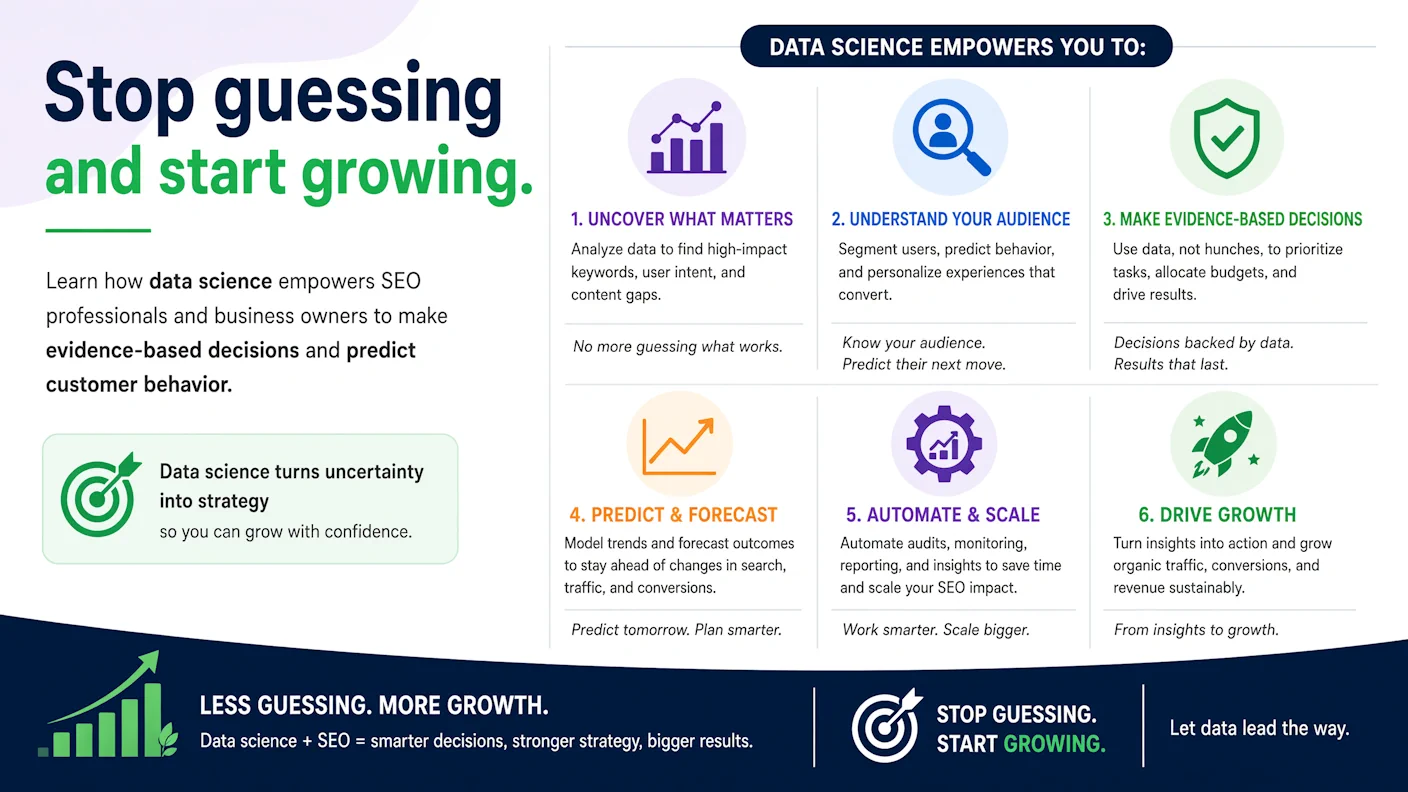

Why Data Science Matters in 2026
Data science sits at the intersection of mathematics, statistics, machine learning, and computer science. At its core, it is the practice of collecting, analyzing, and interpreting data to extract insights that drive better decisions. For businesses operating in the digital space - particularly those focused on SEO and content strategy - understanding data science is no longer optional.
The global data science platform market continues its rapid expansion. According to Precedence Research, the market is projected to grow at a compound annual growth rate (CAGR) of over 16% through 2030. Organizations across every sector are investing heavily in data-driven decision-making, and the SEO industry is no exception.
Data science enables businesses to predict customer behavior and identify emerging trends, detect fraud and optimize internal processes, improve product development through evidence-based iteration, and deliver personalized experiences at scale. For SEO professionals, it means moving beyond gut instinct toward measurable, repeatable strategies backed by real data.
The Four Pillars of Data Analysis
Understanding data science requires familiarity with four distinct analysis approaches.
Descriptive Analysis answers the question "What happened?" by organizing and summarizing raw data into meaningful patterns. In SEO terms, this is your traffic dashboard showing page views, bounce rates, and keyword rankings over time.
Diagnostic Analysis digs deeper into "Why did it happen?" using techniques like data mining and correlation analysis. When your organic traffic drops after a core algorithm update, diagnostic analysis helps identify which pages were affected and why.
Predictive Analysis uses historical data, statistical modeling, and machine learning to forecast "What will happen?" - for example, projecting which content topics will gain search volume in the next quarter based on trend data.
Prescriptive Analysis goes furthest by recommending "What should we do about it?" It leverages neural networks, simulation, and recommendation engines to suggest optimal actions. This is where AI-powered SEO tools truly differentiate themselves.
How Machine Learning Powers Modern SEO Tools
Machine learning (ML) is the engine inside data science that makes accurate predictions and classifications possible without explicit programming for every scenario. Instead of writing rules for every edge case, you train a model on labeled data and let it learn the patterns.
A Real-World Example: Screen Overlay Classification
At OnPagePilot, we use machine learning directly in our platform. One concrete example is our screen overlay classification model, built with ML.NET and TensorFlow. When our crawlers visit websites for SEO analysis, they frequently encounter screen overlays - cookie consent banners, CAPTCHA challenges, and other popups - that obstruct the actual page content.
Rather than relying on brittle CSS selectors or hard-coded rules, we trained an image classification model using transfer learning on the ResNet V2-101 architecture. The model classifies screenshots into four categories: Clean (no overlay), Cookie Consent, CAPTCHA Challenge, and Other Overlay.
This approach uses the ML.NET Image Classification API with TensorFlow transfer learning, which retrains the final layers of a pre-trained deep neural network on our own labeled training data. The result is a model that runs directly inside our .NET application - no external API calls, no cloud dependency, no per-request cost.
What is transfer learning? Instead of training a neural network from scratch (which requires millions of images and hundreds of GPU hours), you start with a model that already understands visual features like edges, textures, and shapes, then fine-tune it on your specific classification task. This is both faster to train and more accurate with small datasets.
Why This Matters for SEO Data Quality
If a crawler takes a screenshot of a cookie consent banner instead of the actual page content, every downstream analysis - content scoring, image gap detection, schema validation - starts from corrupted data. Our ML model acts as a data quality gate: it classifies each screenshot before it enters the analysis pipeline, ensuring that only clean page captures are used for SEO evaluation.
Bad data in means bad insights out. Machine learning helps us prevent that at the source.
The Data Science Process
Whether you are building an ML model or analyzing keyword data, the data science workflow follows a consistent pattern.
1. Data Collection - Identify and gather the data you need. In SEO, this might be crawl data, search console exports, or third-party API responses from providers like DataForSEO.
2. Data Cleaning - Ensure the data is accurate, complete, and consistently formatted. Missing values, duplicate entries, and encoding issues must be resolved before analysis. This step typically consumes the majority of a data scientist's time.
3. Exploratory Analysis - Visualize the data to identify patterns, outliers, and anomalies. Attention to detail here prevents false conclusions downstream.
4. Modeling - Apply statistical models or machine learning algorithms to the prepared data. The algorithm iteratively learns from the training data to produce predictions or classifications.
5. Interpretation and Communication - Present findings in a way that stakeholders can act on. The most sophisticated model is worthless if its insights cannot be explained clearly.
Key Tools and Technologies
The data science ecosystem includes specialized tools for each stage of the workflow.
For data analysis, tools like Python (with pandas and NumPy), R, and SQL remain foundational. For data visualization, Tableau, Jupyter notebooks, and Plotly help communicate findings effectively. For machine learning, frameworks like TensorFlow, PyTorch, scikit-learn, and ML.NET provide the building blocks for model training and deployment.
The choice of framework often depends on your technology stack. Python dominates in research and startups. For enterprise .NET applications - like OnPagePilot - ML.NET provides a natural integration path that keeps the entire pipeline in C#, from data ingestion to model inference.
Data Science in Business: Practical Applications
Beyond SEO, data science drives value across industries.
Fraud Detection - Financial institutions use ML models to flag suspicious transactions based on patterns in amount, location, timing, and merchant data. Anomalies trigger automatic holds, preventing losses before they occur.
Healthcare - From medical image analysis to drug development and genomics, data science accelerates diagnosis and treatment. Predictive models identify at-risk patients before symptoms escalate.
Recommendation Systems - E-commerce platforms and streaming services use collaborative filtering and content-based algorithms to suggest products, shows, and content tailored to individual preferences.
Search Engines - Every search query you run through Google, Bing, or any other engine is processed through layers of data science algorithms that rank results by relevance, freshness, authority, and user intent.
The Evolving Role of Data Scientists
The data science profession is maturing rapidly. According to MIT Sloan Management Review, the focus in 2026 is shifting from individual experimentation toward enterprise-level AI deployment. Foundation models are changing the workflow, and AutoML tools are automating much of the routine model-building work.
This does not mean data scientists are becoming obsolete - quite the opposite. The role is evolving from pure technical execution toward a blend of analytical thinking, business acumen, and system-level design. The ability to frame the right question, evaluate model outputs critically, and communicate results to non-technical stakeholders is more valuable than ever.
For organizations building SEO platforms and analytics tools, this evolution means investing in data infrastructure, model governance, and - critically - data quality at the source.
Getting Started with Data Science
If you are considering data science as a discipline for your team or career, the path is straightforward.
Start with the fundamentals: statistics, probability, and linear algebra provide the mathematical foundation. Learn Python as your primary programming language, along with SQL for data access. Build familiarity with machine learning concepts - supervised vs. unsupervised learning, classification vs. regression, overfitting, and cross-validation.
Most importantly, work on real problems. Kaggle competitions and textbook exercises build skills, but applying data science to actual business challenges - like improving crawl data quality or predicting content performance - is where lasting expertise develops.
Conclusion
Data science is not a buzzword. It is a discipline that combines statistical rigor, computational tools, and domain expertise to turn raw data into actionable knowledge. For SEO professionals and digital businesses, it is the foundation upon which modern analytics, automation, and AI-powered tools are built.
Whether you are using data science to analyze keyword trends, classify page screenshots with machine learning, or forecast content performance, the principles remain the same: collect good data, clean it thoroughly, analyze it honestly, and communicate your findings clearly.
The organizations that treat data as a strategic asset - and invest in the science to extract its value - will continue to lead.
Further Reading
- ML.NET Image Classification with Transfer Learning - Microsoft's tutorial on building custom image classifiers with TensorFlow and ML.NET
- TensorFlow Transfer Learning Guide - Retraining image classifiers using TensorFlow Hub
- MIT Sloan: Five Trends in AI and Data Science for 2026 - Expert analysis on where the field is heading
- Data Science Trends 2026 - TinyML, AutoML, and cloud migration trends shaping the industry
- McKinsey Global Tech Agenda 2026 - How leading companies are investing in AI and data