
Why On-Page SEO Still Matters in 2026
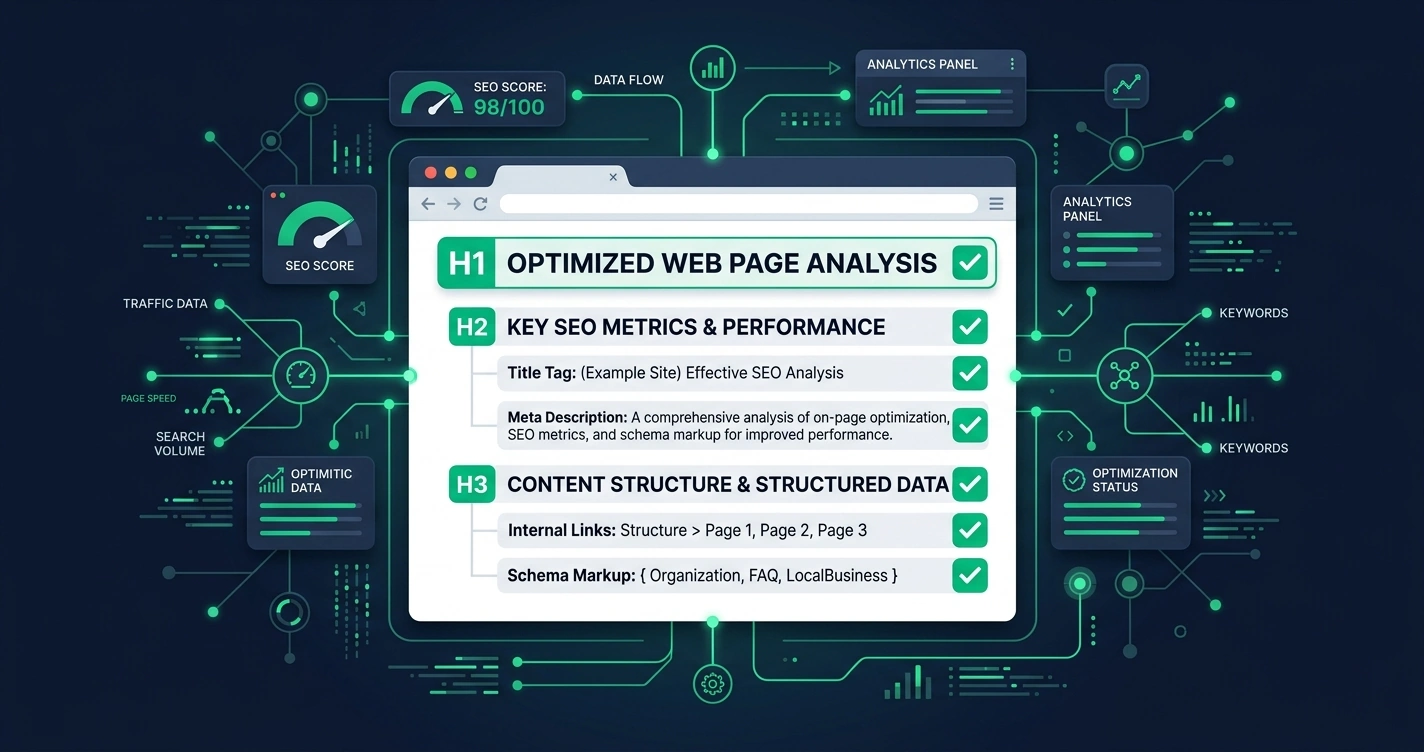
On-page SEO is the practice of optimizing individual web pages so they rank higher in search engines and get cited by AI answer systems. It covers everything you control directly on your page: content quality, title tags, meta descriptions, header structure, internal links, image optimization, and structured data markup. If off-page SEO is your reputation, on-page SEO is the substance behind it.
The stakes have never been higher. According to Google's own documentation on how ranking works, the most basic signal that content is relevant is the presence of keywords matching the user's search query — combined with signals that measure expertise, authoritativeness, and trustworthiness. On-page SEO is where you establish all of these signals.
In 2026, a single page must satisfy Google's traditional ranking algorithm, AI Overview systems, third-party answer engines like ChatGPT and Perplexity, and human readers — all simultaneously. The pages that accomplish this are not lucky. They are optimized.
On-Page SEO vs. Off-Page SEO vs. Technical SEO
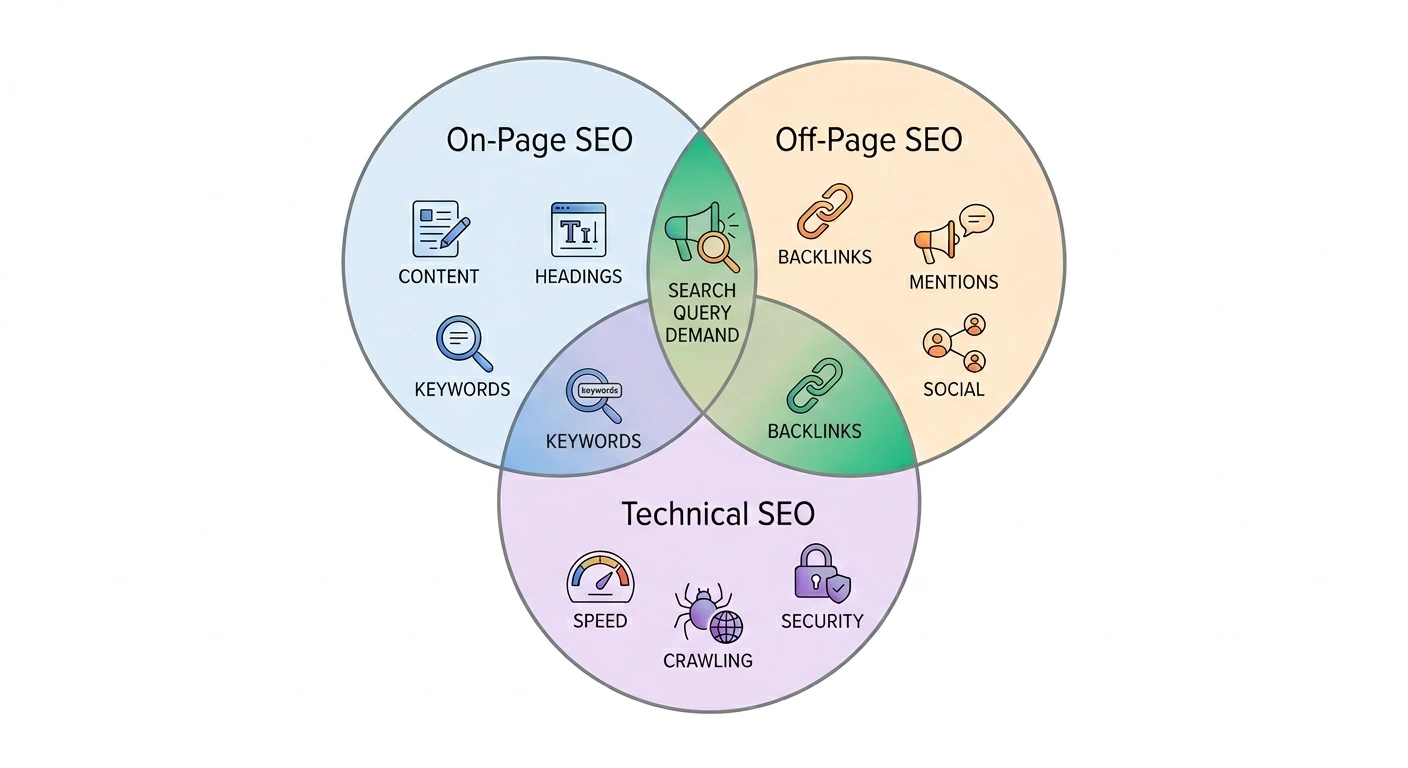
Before going deeper, it is worth clarifying where on-page SEO sits within the broader SEO discipline. There are three core pillars.
On-page SEO refers to optimizations you make directly on the page you want to rank — content, headings, meta tags, keyword placement, internal links, images, and structured data. These are the elements you have full control over.
Off-page SEO refers to signals generated outside your website that indicate authority and trust. Backlinks from other sites, brand mentions, social signals, and digital PR all fall into this category. You influence these, but you do not control them directly.
Technical SEO refers to site-wide infrastructure: crawlability, indexing, site speed, mobile responsiveness, HTTPS, XML sitemaps, and server configuration. Technical SEO ensures that search engines can access and process your pages efficiently.
Key distinction: On-page SEO is the most directly controllable ranking factor. Every optimization happens on your own site, independent of backlinks or domain authority. When on-page elements are strong, they amplify the impact of your off-page and technical efforts.
The Core Elements of On-Page SEO
On-page SEO encompasses over a dozen factors. Here are the ones that carry the most weight in 2026, organized by impact.
1. Search Intent Alignment
Search intent is the reason behind a query. Google's systems evaluate whether your page genuinely satisfies what the user was looking for — not just whether it mentions the right keywords. If someone searches "what is on-page SEO," they expect a clear definition and practical guidance, not a sales pitch for an SEO agency. Before writing a single word, examine the top-ranking results for your target keyword. The format and depth they share reveal the intent blueprint you need to match.
2. Title Tags
The title tag is the single most important HTML element for on-page SEO. It appears in search results, browser tabs, and social media shares. An effective title tag includes the primary keyword naturally, communicates what the reader will gain, and stays under 60 characters to avoid truncation in search results. Google's SEO Starter Guide specifically recommends creating unique, descriptive titles for each page.
3. Meta Descriptions
Meta descriptions do not directly influence rankings, but they directly influence click-through rates. A compelling meta description acts as an advertisement for your page in the search results. Keep it under 155 characters, include the primary keyword, and write it as a clear value proposition that tells the searcher exactly what they will find on the page.
4. Header Structure (H1–H3 Hierarchy)
Headers serve two purposes: they help readers scan content quickly, and they help search engines understand the topical structure of your page. Every page should have exactly one H1 tag containing the primary topic. H2 tags mark major sections. H3 tags mark subsections. This hierarchy is not decorative — it is semantic. AI systems increasingly rely on well-structured headings to extract and cite content in AI-generated answers.
5. Content Quality and Depth
Content is the backbone of on-page SEO. In 2026, Google's ranking systems increasingly favor content that demonstrates what they call E-E-A-T: Experience, Expertise, Authoritativeness, and Trustworthiness. Content that is generic, thin, or obviously paraphrased from existing top-ranking pages performs poorly. Content that includes original data, first-hand evidence, or a unique analytical framework earns visibility.
The goal is not to write the longest article. The goal is to be the most complete and useful answer for the specific query your page targets. A 600-word post with one original benchmark can now outrank a 3,000-word guide that merely repackages existing information.
6. Keyword Placement
Strategic keyword placement confirms to search engines that your page is genuinely about the topic it claims to cover. Include your primary keyword in the title tag, the H1, the first 100 words of body content, at least one H2, and in the URL slug. Use related terms and synonyms naturally throughout the content — this signals topical depth without keyword stuffing.
Pro Tip: There is no magic keyword density number. The principle is straightforward — mention your target keyword enough times that search engines can confidently identify the page's topic, but never at the expense of natural readability.
7. URL Structure
Clean, descriptive URLs help both users and search engines understand what a page is about before they even visit it. A URL like /blog/what-is-on-page-seo is immediately clear. A URL like /blog/post?id=4872 is not. Include your primary keyword in the URL, use hyphens to separate words, and keep it concise. Avoid adding dates to URL slugs unless absolutely necessary — you may want to update the content later.
8. Internal Linking
Internal links connect your pages to each other, distributing authority across your site and helping search engines discover and understand the relationships between your content. Every important page should receive internal links from related pages, and every new piece of content should link out to existing relevant pages. Use descriptive anchor text that tells both users and search engines what the linked page is about.
9. Image Optimization
Images enhance user experience, but unoptimized images can destroy page speed. Every image should have a descriptive alt text attribute that explains what the image shows — this is critical for accessibility and for image search visibility. Compress images before uploading, use modern formats like WebP, and specify width and height attributes to prevent layout shifts during page load.
10. Structured Data (Schema Markup)
Structured data uses a standardized vocabulary from Schema.org to explicitly tell search engines what your content represents. Adding JSON-LD markup for articles, FAQs, products, reviews, or how-to guides enables rich results in search — star ratings, FAQ dropdowns, recipe cards, and more. Structured data does not guarantee a ranking boost, but it improves how your page appears in search results, which directly impacts click-through rates.
Page Experience and Core Web Vitals
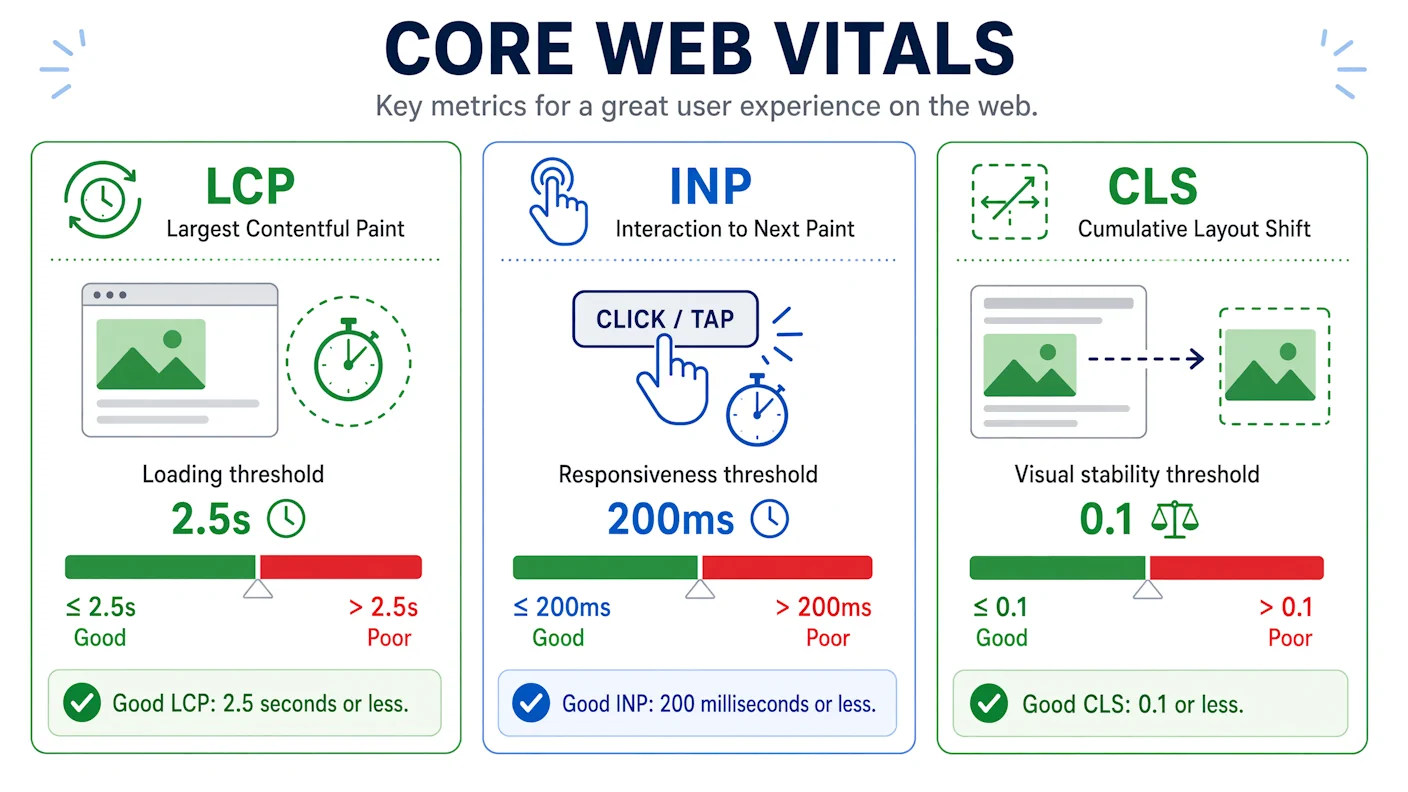
On-page SEO in 2026 extends beyond content and HTML elements to include measurable user experience metrics. Google's Core Web Vitals are three specific performance measurements that function as ranking signals.
Largest Contentful Paint (LCP) measures loading performance — how quickly the main content of the page becomes visible. The target is under 2.5 seconds.
Interaction to Next Paint (INP) measures responsiveness — how quickly the page responds when a user clicks, taps, or types. The target is under 200 milliseconds. INP replaced First Input Delay (FID) as a Core Web Vital in March 2024.
Cumulative Layout Shift (CLS) measures visual stability — whether elements on the page shift unexpectedly while loading. The target is a score of 0.1 or less.
When two pages have similar content quality and relevance, Core Web Vitals serve as the tiebreaker. A page that loads in 1.2 seconds with zero layout shift will outperform an equally relevant page that loads in 4 seconds with visible content jumps.
How OnPagePilot Automates On-Page SEO Analysis
Understanding on-page SEO principles is one thing. Systematically applying them across an entire website — hundreds or thousands of pages — is another challenge entirely. This is where automated analysis becomes essential.
At OnPagePilot, our crawlers systematically visit every page on your website, analyzing on-page SEO elements in real time. The platform evaluates title tags, meta descriptions, header hierarchies, content structure, image optimization, internal linking patterns, and page speed — then surfaces specific, actionable recommendations for each page.
What makes this analysis accurate is data quality at the source. Our crawlers use machine learning models built with ML.NET and TensorFlow to classify screenshots of every page they visit, detecting cookie consent banners, CAPTCHA challenges, and other overlays that would otherwise corrupt the analysis. Only clean page captures enter the analysis pipeline — because bad data in means bad insights out.
Why this matters: If a crawler takes a screenshot of a cookie banner instead of the actual page content, every downstream analysis — content scoring, image gap detection, schema validation — starts from corrupted data. Machine learning acts as a data quality gate, ensuring that on-page SEO analysis reflects what users actually see.
On-Page SEO for AI Search Engines
In 2026, on-page SEO is no longer just about Google's traditional blue links. AI-powered search systems — Google's AI Overviews, ChatGPT, Perplexity, and others — pull answers directly from web pages and synthesize them into responses. Pages that are clearly structured, factually accurate, and formatted for easy extraction are significantly more likely to be cited.
To optimize for AI answer engines, follow these principles. Use clear question-and-answer formats within your content. Provide concise, definitive statements at the beginning of each section. Use numbered lists and structured headings that make information easy to extract. Include specific data points, percentages, and named sources that AI systems can attribute. Avoid burying your primary value behind lengthy introductions — place your most important answer above the fold.
The good news is that what works for AI search also works for traditional search. Clear structure, factual depth, and authoritative sourcing are universal ranking signals regardless of which system is evaluating your content.
Common On-Page SEO Mistakes
Even experienced webmasters make on-page SEO errors that silently cost them rankings. Here are the most damaging ones.
Missing or duplicate title tags — Every page on your site needs a unique title tag that accurately describes its specific content. Pages sharing the same title compete against each other in search results.
Ignoring search intent — Publishing a product page when Google expects an informational guide, or vice versa, is a fundamental mismatch that no amount of keyword optimization can overcome.
Thin content — Pages with only a few paragraphs of generic text provide no value that competitors' pages do not already offer. If your page does not give the reader a reason to stop searching, it will not rank.
Neglecting internal links — Orphan pages with no internal links pointing to them are invisible to both search engines and users. Every important page needs to be connected to the rest of your site.
Unoptimized images — Large, uncompressed images without alt text hurt page speed, accessibility, and image search visibility simultaneously.
No structured data — Without schema markup, you are relying entirely on search engines to interpret your content correctly. Structured data removes ambiguity and enables richer search presentations.
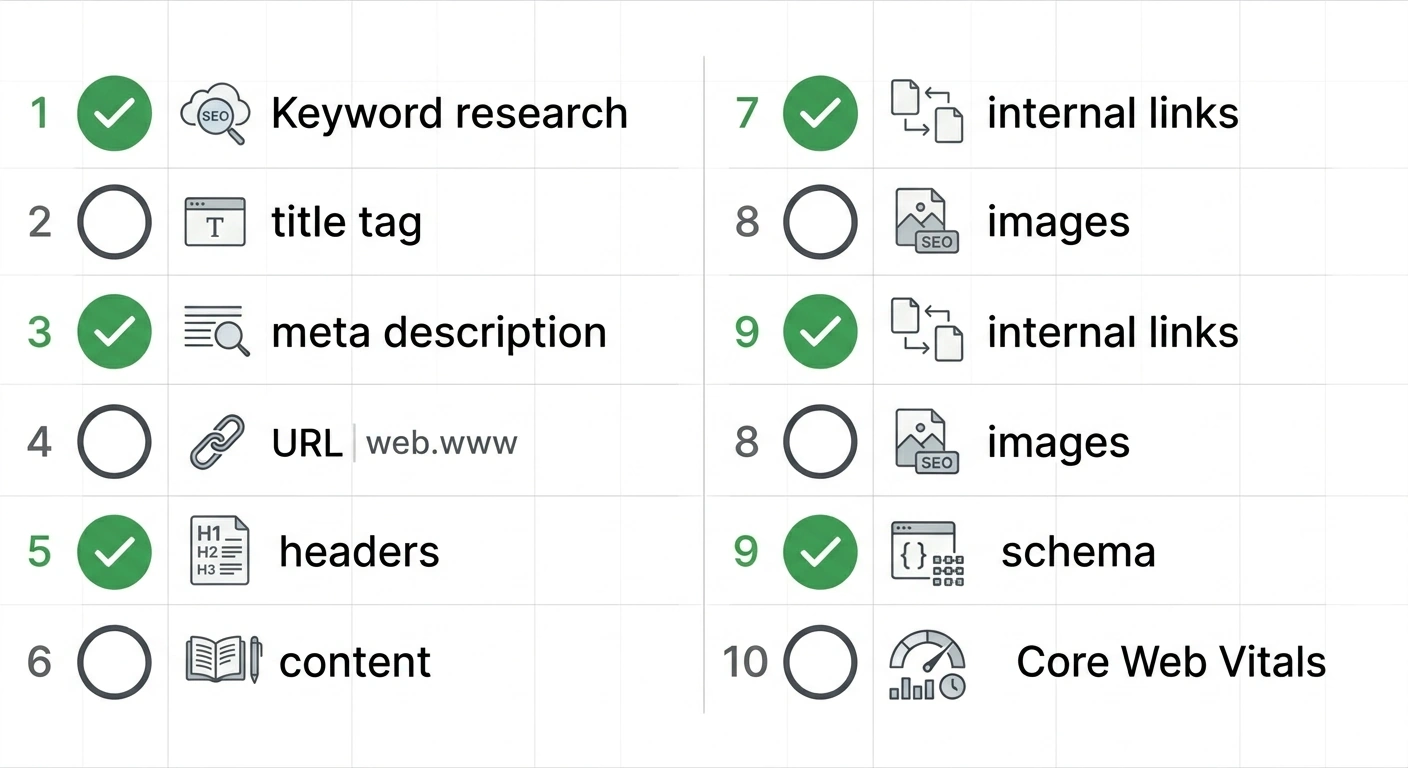
An On-Page SEO Checklist for 2026
Use this as a practical reference for every page you publish or optimize.
1. Keyword research — Identify one primary keyword and two to three related terms for each page. Verify search intent by examining current top-ranking results.
2. Title tag — Include the primary keyword. Stay under 60 characters. Make it compelling enough to earn the click.
3. Meta description — Write a clear value proposition under 155 characters. Include the primary keyword. End with a reason to click.
4. URL structure — Use a clean, keyword-inclusive URL with hyphens separating words. No dates, no parameters, no unnecessary depth.
5. Header hierarchy — One H1 per page containing the primary topic. H2s for major sections. H3s for subsections. Logical, scannable structure.
6. Content — Match search intent completely. Include the primary keyword in the first 100 words. Provide genuine depth, original insight, or unique data. Every paragraph must earn its place.
7. Internal links — Link to three to five related pages on your site. Use descriptive anchor text. Ensure this page receives internal links from other relevant pages.
8. Images — Compress all images. Use descriptive alt text. Specify width and height. Use WebP format where supported.
9. Structured data — Add relevant JSON-LD schema markup. Validate with Google's Rich Results Test or the Schema.org Markup Validator.
10. Core Web Vitals — Test with PageSpeed Insights. Target LCP under 2.5 seconds, INP under 200 milliseconds, CLS under 0.1.
Conclusion
On-page SEO is the foundation upon which all other SEO efforts build. Without strong on-page signals — clear intent alignment, authoritative content, optimized HTML elements, fast load times, and structured data — no amount of backlinks or technical optimization will deliver sustainable rankings.
The discipline has evolved significantly. In 2026, it means optimizing not just for Google's traditional algorithm, but for AI answer engines, voice assistants, and increasingly sophisticated user experience measurements. The core principles, however, remain unchanged: create content that genuinely helps users, structure it so machines can understand it, and deliver it fast.
The websites that treat on-page SEO as a systematic, page-by-page discipline — rather than a one-time checklist — are the ones that consistently win visibility, traffic, and conversions.
Further Reading
- Google SEO Starter Guide — Google's official best practices for making your site search-engine friendly
- How Google Determines Ranking Results — Google's explanation of the signals used to rank content
- Web Vitals — Google's documentation on Core Web Vitals metrics, thresholds, and measurement
- Getting Started with Schema.org — Practical introduction to structured data markup for your website
- The Most Effective Ways to Improve Core Web Vitals — Google's guide to optimizing LCP, INP, and CLS