The 200-Keyword Report That Was Built for a Dead Machine
You know the moment. The agency deck arrives, and there it is: a spreadsheet
with 200 keywords, color-coded by search volume and difficulty. It looks like
science. It feels like progress. In 2026, it is neither - because that
report was built for a search engine that stopped existing more than a decade
ago.
Google stopped counting words in 2013. That was the year the
shift toward language understanding began in
earnest, and every major update since has moved in one direction: away from
"how many times did you say it" and toward "what do you actually mean." Modern
AI engines - ChatGPT, Perplexity, Gemini - have taken that shift to
its logical conclusion. They do not count your keywords at all. They read your
meaning.
Here is the part no one selling you that spreadsheet will say out loud:
stuffing those 200 keywords into your pages does not just fail to help anymore.
It actively makes you harder for AI to cite. Every repeated phrase is
space that could have held real information - and real information is the
only currency AI engines trade in.
Four numbers that end the keyword-density debate:
2013 - the year Google's Hummingbird update replaced
word-matching with semantic search. ~1% - the typical
keyword density of top-ranking pages, which is what natural writing produces
anyway. 0 - how much AI engines care about repetition.
75+ - the number of languages Google's MUM model
understands by concept, not by word.
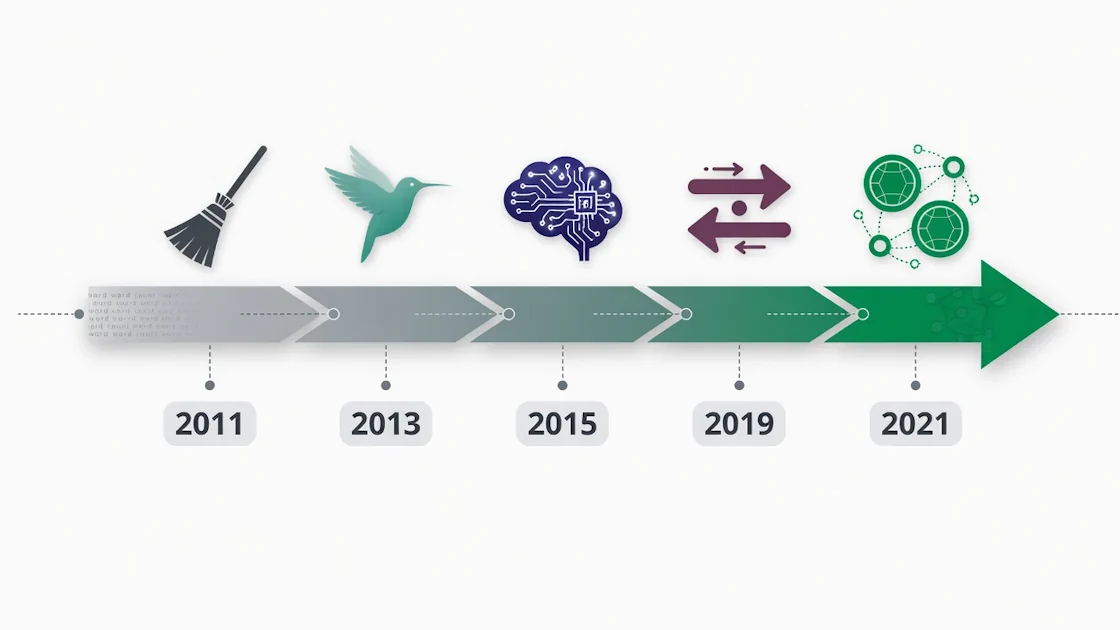
A Decade of Google Telling Us the Same Thing
The move away from word-counting was not one update. It was a fifteen-year
campaign, and every milestone pointed the same direction.
Panda (2011) was the opening shot. It demoted thin,
repetitive content farms - pages engineered around phrases instead of
answers. The message: quantity of words is not quality of information.
Hummingbird (2013) was the engine swap. Google replaced its
core algorithm with one built for semantic search - understanding intent
and the relationships between things, not matching strings of characters. It
affected roughly 90% of queries on day one, and most people never noticed,
because results simply got better.
RankBrain (2015) added machine learning to interpret
queries Google had never seen before, mapping unfamiliar phrasings onto
familiar meanings.
BERT (2019) taught Search to read context in both
directions. As Google explained in its
BERT announcement, the model processes every
word in relation to all the other words in a sentence - which is why a
preposition like "to" in "brazil traveler to usa" suddenly mattered. Google's
own framing was telling: it hoped users could finally "let go of keyword-ese"
and search the way they naturally speak.
MUM (2021) pushed past language entirely. Google's
Multitask Unified Model is trained across 75
languages and multiple formats at once, transferring knowledge between them. A
concept written in Japanese can answer a question asked in Danish. There is no
keyword in that transaction - only meaning.
Notice the pattern. Not one of these updates made exact-match keywords more
important. Every single one made them less so. The direction has never
wavered; only the speed has changed.
How a Machine Actually Reads Your Page
Forget the jargon for a moment. When a modern search or AI system reads your
content, it converts every word, sentence, and paragraph into positions in a
vast mathematical space. Words and phrases with related meanings land close
together; unrelated ones land far apart. "Affordable dental implants,"
"low-cost tooth replacement," and "cheap options for missing teeth" cluster in
nearly the same spot - even though they share almost no words.
Embedding: a numeric representation of
text that captures its meaning as coordinates in high-dimensional space. Two
passages that mean the same thing sit close together - regardless of
which words they use. This is the mechanism behind semantic search and every
modern AI engine's reading comprehension.
The practical consequence is liberating: write naturally and completely,
and the machine understands you - even if you never use the exact phrase
someone typed. Repeating "best plumber Copenhagen" eleven times does not move
your page closer to the searcher's intent in that space. Explaining what you
actually do, for whom, at what price, with what guarantees - that
does.
This is also why measuring keyword density is measuring the wrong thing
entirely. The machine is not asking "how often does this phrase appear?" It is
asking "what does this page know?"

Keywords Aren't Dead. The Way They're Sold to You Is.
Let's be honest about something the contrarian takes usually skip: keyword
research still matters. It tells you what your market calls things, which
questions they ask, and where demand actually is. The problem is not the
research. The problem is the deliverable - an orphaned list, handed over
with an invoice, detached from everything that makes it useful.
A keyword without a topic cluster around it, without internal links feeding
it authority, without a site architecture that tells search engines how it
relates to everything else you know - that keyword is a map of a city
that has since been demolished. Accurate once. Useless now.
| Keywords sold as a list |
Keywords woven into a system |
| A spreadsheet of 200 phrases |
A topic map showing what you know and how it connects |
| Each page targets one phrase |
Each page answers a question completely, in natural language |
| Success = rankings for exact terms |
Success = visibility across search, AI answers, and citations |
| Ends when the report is delivered |
Feeds interlinking, clustering, and content planning continuously |
Why Keyword Stuffing Makes You Invisible to AI
With classic Google, keyword stuffing was merely against the rules.
Google's spam policies explicitly list it -
repeating words or phrases so often that it sounds unnatural - as a
practice that gets pages demoted or removed. That threat has existed for
years. What is new is that with AI engines, stuffing carries a second,
quieter penalty that no policy needs to enforce.
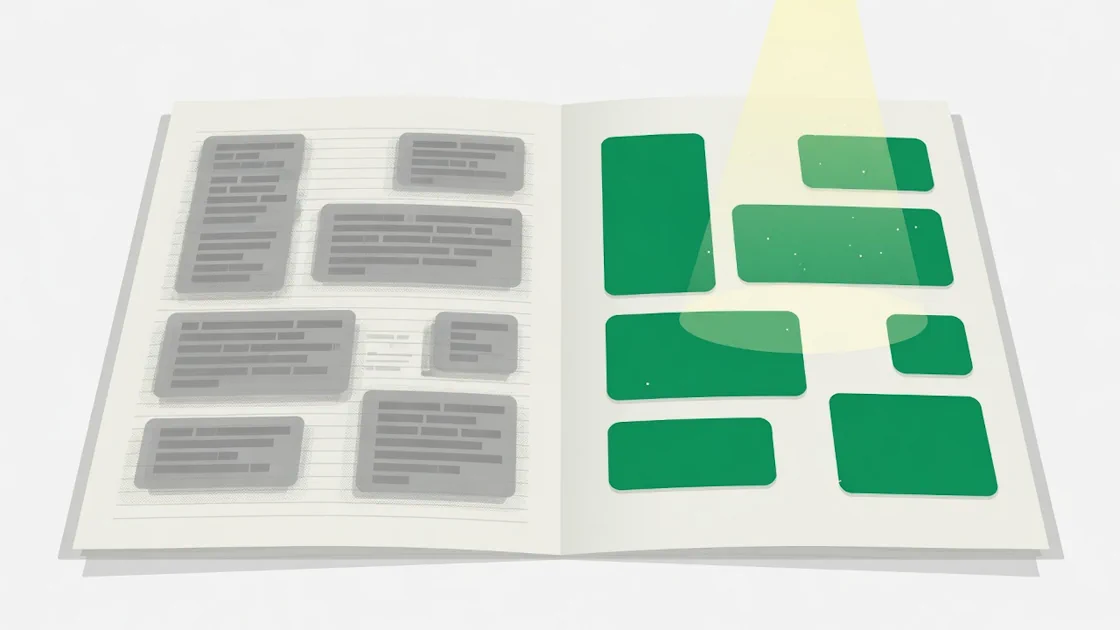
Think of your page as finite space. Every sentence either adds information
an AI can use - a fact, a price, a comparison, a first-hand observation
- or it does not. A stuffed phrase adds nothing; it restates what the
page already said. Repeat it enough times and the ratio of information to
words collapses. AI engines deciding what to cite are, in effect, looking for
the densest, clearest source of the answer. A diluted page loses that contest
to a competitor who spent the same word count actually saying something.
The counterintuitive truth: keyword
stuffing does not make AI notice you more. It makes AI notice you
less - because every stuffed phrase displaces the real
information an AI engine needs before it will cite you as a source.
Query Fan-Out: There Is No Single Keyword Left to Target
If semantic search weakened the case for exact-match keywords, AI search
removes it. When Google launched AI Mode, it
described a technique called query fan-out:
the system breaks a user's question into subtopics and issues a multitude of
queries simultaneously, then synthesizes one answer from many sources.
ChatGPT, Perplexity, and Gemini work the same way in principle -
decompose, retrieve, synthesize.
Ask "what should I do differently to prepare for hiking Mt. Fuji after
Mt. Adams," and the engine quietly runs searches on elevation, seasonal
weather, trail difficulty, and gear - sub-questions the user never
typed. Which keyword on your page was supposed to catch that? There isn't
one. The engine is not matching your page against a phrase. It is deciding
whether your page contributes a piece of the synthesized answer.
That changes the unit of measurement. Visibility is no longer "position 3
for keyword X." It is: how often do AI engines cite you when assembling
answers in your domain? Rankings measured the old machine. Citations
measure the one that matters now.
What to Do Instead: Weave Keywords Into a System
The fix is not abandoning keywords. It is putting them back where they
belong - as inputs to a content system, not as the product itself. Five
moves cover most of it:
1. Map topics, not phrases - Group your keyword
research into clusters of related intent. One complete page per cluster beats
ten thin pages per phrase, both in rankings and in AI citations.
2. Answer completely - Every page should resolve its
question so thoroughly that an AI engine synthesizing an answer has a reason
to pull from you. Include the specifics only you have: your data, your prices,
your process, your experience.
3. Interlink deliberately - Internal links tell both
search engines and AI crawlers how your knowledge connects. A cluster without
links is just a list again. Our guide to
on-page
SEO covers the mechanics.
4. Write for humans, verify for machines - Natural
writing lands you at that ~1% keyword density automatically. Then check the
technical layer: headings that state the question, structure that machines can
parse, no dilution.
5. Measure citations, not just rankings - If AI
answers are where your buyers now get recommendations, you need to know
whether you appear in them.
How OnPagePilot Closes the Loop
This is exactly the gap OnPagePilot was built for. Instead of handing you a
keyword list and walking away, the platform treats keywords as one input into
a connected system: keyword research feeds topic clustering, clustering feeds
the content editor, internal linking analysis shows how your pages support
each other, and LLM visibility tracking measures the outcome that actually
matters - how often AI engines cite your domain when answering questions
in your market. When a page is diluted or a cluster is missing its connecting
links, you see it as data, not as a hunch.
In other words: the keyword report is still in there. It just stopped being
the product and became what it always should have been - the raw
material.
Conclusion
Search engines stopped counting words in 2013. AI engines never started.
Every year since Hummingbird, the machines that decide your visibility have
gotten better at one thing: reading meaning. A standalone keyword report
optimizes for the machine that no longer exists; information-dense, naturally
written, well-connected content is chosen by the one that does.
So the real question for your next content investment is not "which
keywords should we rank for?" It is "what do we know that no one else has
written down?" Answer that, structure it properly, and both Google and the AI
engines will find you - without a single stuffed phrase.
If you want to see how visible your site already is to AI engines -
and where the gaps are - that is precisely what OnPagePilot measures.
Let's talk.
Further Reading