Five years of papers pointing one way
The 2026 paper didn't arrive from nowhere. Click each step to see what it contributed.
Two stages today, one decoding pass tomorrow
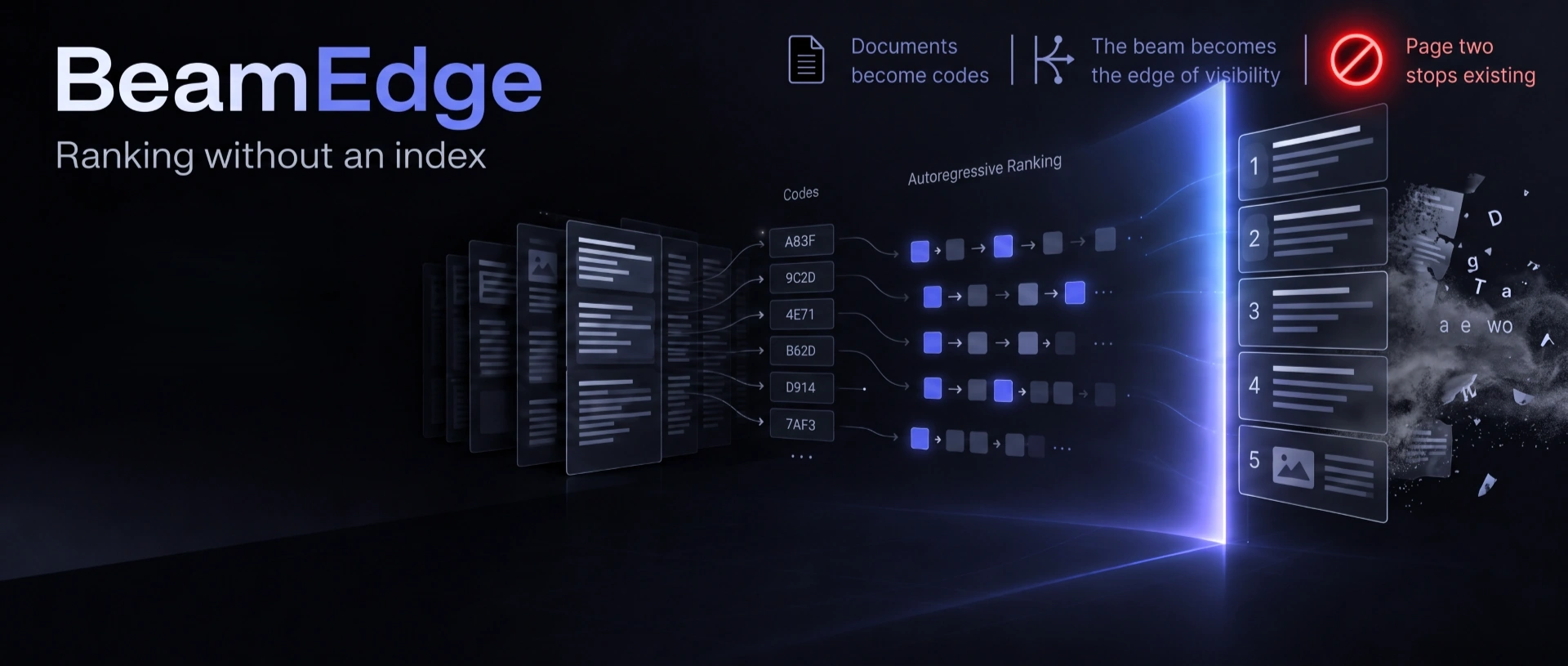
Today a cheap dual encoder retrieves a long candidate list from a nearest-neighbour index and an expensive cross encoder reranks the top of it. The paper collapses both into a single generative model that emits document identifiers. Switch between them and watch what happens to the result count.
Position eleven was never generated
A docID is a short token sequence — three digits here, like the shopping experiment where each product's title embedding was compressed to three numbers. Beam search keeps only the k most probable partial codes at each step and discards the rest. A great document whose first digit got pruned at step one doesn't rank badly. It doesn't exist in the output.
Make a model generate the ranking
Assign semantic identifiers to the candidate pages, then generate a ranked set. Live AI requires an existing system session. Model scores are demonstration values, not calibrated search-engine measurements. Failed live requests do not become simulated results.
Candidates
Distinctness becomes the thing you optimise
Compare two pages by search intent and meaning. Decision AI reports distinctness, a five-level score and which page better serves their shared intent. This is an evaluation, not a guarantee of search inclusion.
Results appear here. Each probability comes straight from the decision model's answer, not from a text generation.
Check the article's claims against the live web
Ask whether evidence supports a claim and compare the answer with and without web evidence. Source links are references to inspect; an AI decision alone does not establish truth.
Live evidence checks require an existing system session. Do not include personal data or secrets.
Decision, with-web vs without-web confidence, and the sources used will appear here.
Illustrative measurements and limits
Rank-aware training lifts the middle of the list
Move between two illustrative recall profiles. These approximate values come from the supplied commentary; this widget does not reproduce or verify the research experiment.
What the experiments actually were
A foundation, not a deployment — and one configuration got worse at placing the single best result first while improving the rest.
Why cost is the lever
This simplified comparison counts index lookups, separate document scores and generated identifiers. It does not measure latency, energy, provider charges or production cost.
Ask the article
Ask about the concepts illustrated here. The complete answer is checked before display. Do not include personal data or secrets.
Three proportionate moves
Not a rebuild around a research paper. Three things that are worth doing now and cost little if the pure version never ships.