Compare the actual text for this question. A page title or a promise to explain is not the answer.
Preset annotations apply to the original example. Edited texts need a fresh AI assessment.
Put the three pages to the test
Start with an example, edit the three texts and ask your own question. AI assesses the best source, the meaning shared by each pair and whether the post supplies an answer.
Login here with your OnPagePilot account to evaluate this example with AI.
These probabilities describe AI’s judgments of the supplied texts. They do not measure Google rankings, citations, duplicate penalties or visibility in AI answers.
duplicate content and AI visibility
Explore how repeated copy, purposeful teasers and canonical signals affect page clarity in search and AI answers, with three interactive examples.
Login here with your OnPagePilot account to get the full experience.
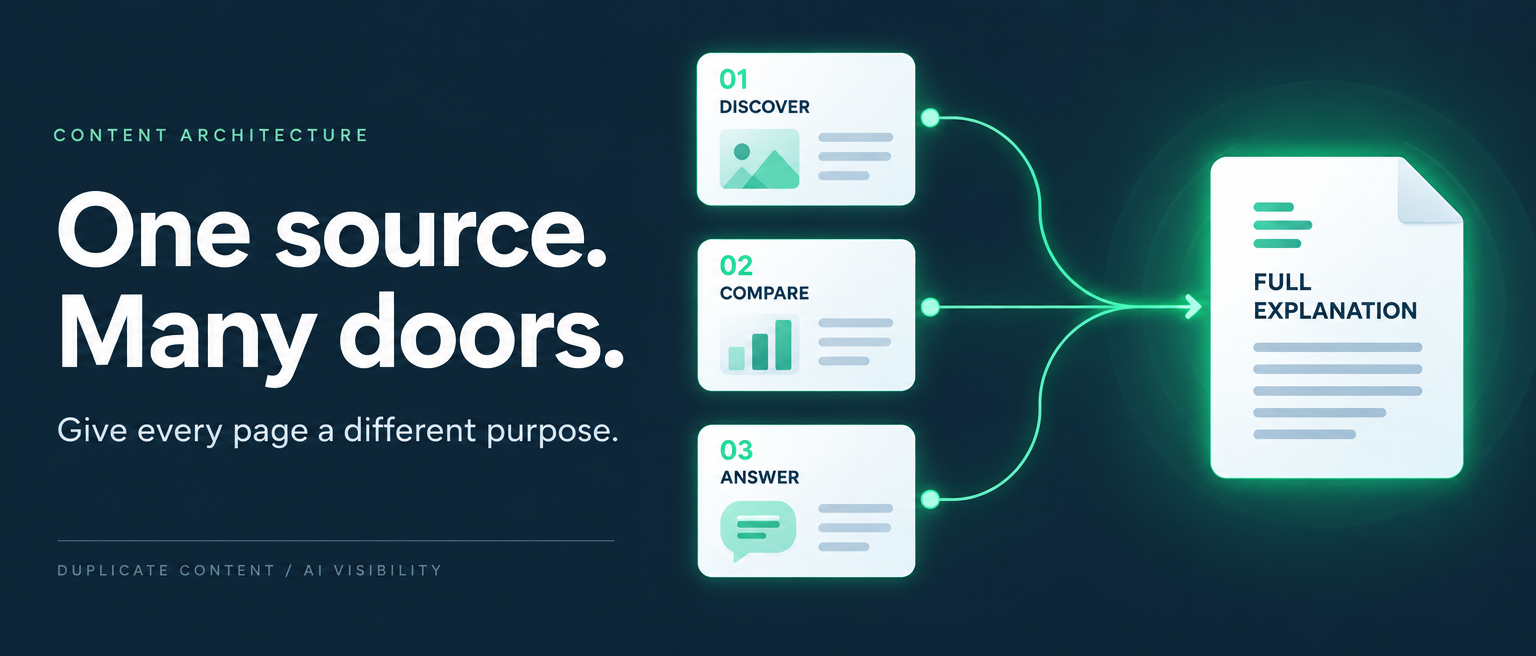
A reader browsing a collection needs a reason to open the next page. A reader asking a precise question needs an answer with enough evidence to support it. Copying the same introduction onto every page makes those different jobs harder to distinguish. A useful content journey gives each page a purpose and makes the complete source easy to reach.
Different entry points can lead to one complete explanation without repeating it.
Watch the same paragraph spread
Imagine a post explaining how to separate a useful teaser from a repeated article. Its collection page copies the introduction. Its blog category copies it again. The post starts with it too. Three URLs now open with the same promise, but only one contains the worked example and conclusions.
Compare three introductions
Collection
/interactive
Explore interactive guides to content clarity, search experiments and source attribution. Start with One article, many doors to compare teasers, BeamEdge to explore generated candidate lists, or the visibility guide to distinguish a mention from a citation. Choose a topic, then open its worked example.
Blog category
/interactive/blog
Three ways to introduce One article, many doors: a copied introduction repeats the answer on every page; a shared excerpt repeats a short invitation; a purpose-written teaser explains why this post belongs here. Compare these approaches in the linked demonstration before choosing an introduction for your own blog hub.
Complete post
/interactive/blog/duplicate-content-ai-visibility
Why can repeated copy obscure the best source? When the collection, category and post give the same answer with the same evidence, the text does not identify a unique source. A distinct collection offers topics and routes; a distinct category compares options; this post supplies the explanation. A shared short excerpt can invite a click without reproducing the full answer. Keep useful hubs on their own permanent URLs; consolidate only genuine duplicate article variants. These examples do not establish which URL a search or answer engine will select.
0 repeated sentences across the example pages. This is a text comparison, not a search or AI visibility score.
In the comparison, switch between a copied introduction, a shared short excerpt and two purpose-written teasers. Repeated sentences are highlighted so you can see what moved. The collection invites exploration; the category explains why this particular post belongs there; the post supplies the analysis. A short excerpt can also be useful. There is no magic word count that turns it into a safe or unsafe teaser.
A shared footer, a repeated brand name or a common navigation label is a different editorial situation from reproducing the main article across several pages. Google describes duplicate handling in terms of the primary content and selecting a representative URL. Duplicate content is not automatically a spam violation. Google's canonicalization guidance.
Which page actually supports the answer?
Change the reader's question. For “what can I explore?”, a collection with clear choices is useful. For “how do these approaches differ?”, a category with useful comparisons can help. For “why did this example fail?”, the detailed post may contain the needed explanation. These are different needs, even when the pages refer to the same subject.
Change the reader’s question
What can I explore?
Look for named topics and a route to the next example, rather than a repeated answer.
Editorial fit in this example does not predict an engine’s source selection.
The source map lets you inspect each example page's evidence. It illustrates editorial fit; it does not predict which URL an answer engine will cite. Giving two teasers different adjectives while keeping the same answer everywhere does not create a meaningful distinction.
Bing's guidance specifically warns that repeated versions can make intent and source selection less clear in SEO and AI search. That is a reason to make page roles explicit, not a promise that rewriting a teaser will produce a citation. Bing on duplicate content and AI search visibility.
Google's AI search features may search related subtopics when constructing an answer. Supporting pages must be indexed and eligible for ordinary search snippets. Existing SEO foundations still apply, and eligibility does not guarantee inclusion. These documented conditions concern Google; other answer engines have their own retrieval and selection behavior. Google's AI features guidance.
What this looks like in OnPagePilot
The page you are reading belongs to a small hierarchy: an interactive collection, an Interactive Blogposts hub, and this complete post. The collection is the broadest doorway. It should tell someone what kinds of ideas they can explore. The blogposts hub narrows that choice to editorial explanations with examples they can change.
That is why we keep two separate teaser sets in our content system. The first introduces a post at the collection level; the second introduces it in its own category. They can have different titles, images, descriptions and link text. Both point to the same permanent post. Neither needs to reproduce its opening paragraph.
For this post, the collection teaser invites readers to give every page a purpose. The category teaser introduces the more specific question of repeated copy obscuring the best source. The complete post then supplies comparisons, references and a way to examine those choices. Each step adds something useful rather than pretending to be another copy of the final answer.
The same discipline applies to an article hub, documentation directory or support collection. A support hub might organize troubleshooting routes by symptom, while the linked document describes the actual repair. Moving the whole repair into every directory makes maintenance harder: an update has to reach every copy, and a reader can encounter conflicting versions.
Write the link as part of the journey
Link text should explain the destination in context. “Read the interactive post” can work beside a clear title and summary. In a paragraph discussing a specific technique, a descriptive link naming that technique is usually more helpful. The objective is a predictable next step, not a manufactured variation for every occurrence of a link.
Images have a job too. A diagram explaining the difference between a hub and a complete post adds information. Reusing the same hero image in a small teaser can help someone recognize the destination, provided its alternative text suits that use. There is no need to manufacture unrelated artwork just to make every image unique.
Before publishing, review the collection, category and post together. Ask what each page helps someone do, whether its title matches that purpose, and whether the link reaches the intended permanent URL. If two pages answer the same question with the same evidence, decide whether both versions really need to remain available.
Choose the treatment that matches the page
Is a URL another version of the same article, a useful hub, or an independent piece answering a different question? The decision explorer asks you to choose that relationship before considering links and canonical signals.
What relationship do the pages have?
Another version of the same article
Choose the preferred permanent URL and align canonical, sitemap and internal-link signals. A redirect may fit a retired alias. Search engines still determine the representative URL.
This exploration explains a choice; it does not change any page’s canonical declaration.
For duplicate variants, consistent canonical signals can help consolidate the preferred URL. For a useful hub with its own content and navigation purpose, the linked article is not automatically its canonical replacement. Keep links directed to the intended permanent URLs. A canonical declaration does not repair unclear writing, and blocking every similar page from indexing can remove useful entry points. Google's guidance on consolidating duplicate URLs.
Record the observation you actually have. A mention and a citation answer different questions.
Measure the content journey with OnPagePilot's LLM Visibility
Once the collection, category and post each have a clear purpose, the next question is what appears in real AI answers. OnPagePilot's LLM Visibility system tracks your brand and competitors across seven AI search and answer surfaces. It brings together the tracked questions, recorded answers, cited sources, sentiment, scan history and competitive share of voice, so you can move from an overview to the evidence behind it.
Track the questions that reveal different needs
Choose the market, language, AI platforms and scan schedule for the topics you track. Related questions can be explored by intent: informational, comparison, transactional, navigational and opinion. That gives the three page roles in this post a practical test. Which questions need a useful overview, which need a comparison, and which require the complete explanation?
For a fictional bicycle shop, an informational question might ask, "What should I check before choosing a city bicycle?" A comparison question might ask, "Which bicycle shops explain fitting options clearly?" A question such as "Is North Cycle suitable for commuters?" already names the brand. OnPagePilot separates those named questions into a Reputation reading. Unprompted visibility measures discovery without putting the brand's name into the question.
Read the answer and the pages behind it
In Prompts Analysis, expand a tracked topic to inspect its questions and the answers recorded for each platform. Review whether the brand appears, how it is described and which URLs are cited. Source Analysis follows those citations back to the source domains and the questions associated with them. You can inspect your own sources and competing sources instead of guessing which page supplied the evidence.
These observations answer different questions. A brand can be named without a link to its website. Its site can be cited through a category or guide instead of the page you expected. Positive, neutral and negative sentiment describe how a recorded answer presents the brand. Read the actual answer and cited URL alongside the classification before deciding what to change.
Compare your position across platforms, intent and time
The AI Share of Voice dashboard compares your observed brand presence with the competitors you track. Its trend and leaderboard show the competitive picture; platform and intent breakdowns, gaps and the heatmap help you find where that picture differs. Scan history and daily share-of-voice snapshots provide a record over time. Keep the selected brand, period, platforms and question scope consistent when comparing results, and inspect the scan dates and available coverage.
A citation observed in one recorded answer establishes that occurrence. A higher share of voice describes the measured competitive sample. Neither establishes why a change happened. The overlap counter and AI assessment in this blogpost examine the texts you supply here; the LLM Visibility system examines recorded answers to your tracked questions. Use each result for the question it actually measures.
Turn an observed gap into a content decision
Choose a specific gap. Find a tracked question or platform where a competitor appears and your brand does not, then open the recorded answer and cited pages.
Check which page should answer it. If a useful comparison is missing, improve the category. If the question needs a worked explanation, strengthen the complete post. Use the collection and teasers to guide readers to that evidence.
Connect the finding to the rest of OnPagePilot. Use Topical Authority to examine coverage, the SEO Editor to develop the answer, and Technical Audit to investigate access and page problems.
Record and publish a bounded change. Note the affected URL, the actual change and its date. Changing a teaser, redirecting a duplicate and adding new evidence are separate interventions.
Review the next recorded scans. Compare the same question scope, read the answers and citations, and follow the trend. Include missing or failed observations in your interpretation instead of treating them as successful checks.
Return to the bicycle example: if an answer cites a competitor's fitting guide, first inspect what that guide explains. Your collection may already introduce the subject well while your complete post lacks the fitting steps. Repeating the collection's introduction on another URL adds no explanation. Improve the page that can answer the question, give it a useful route from the hub, and check subsequent recorded answers.